Recognition matters. A brand people cannot recognize has fewer opportunities to be considered, chosen, remembered, or interpreted in the first place. If customers do not know a brand exists, cannot retrieve it in a relevant moment, or fail to recognize its distinctive signals, the brand has a practical disadvantage before the decision has even begun. But recognition is not the same as value. It is not the same as relevance. It is not the same as meaning. And it is not evidence of irreplaceability.
Recognition is visible, measurable, and seductive. Awareness rises. Search increases. A campaign enters conversation. A familiar asset appears across a shelf, a feed, a storefront, or a screen. Sales may rise. All of those outcomes can matter commercially. What they do not tell an organization by themselves is what value the brand has actually created, or what people would lose if they replaced it. That distinction sounds obvious once stated. In practice, it is one of the most common strategic errors in brand management.
Recognition Is a Threshold, Not an Outcome
Recognition makes a brand available for interpretation. It can arrive through a shelf, a recommendation, a search result, a social post, an advertisement, a cultural moment, a retail environment, a product encounter, or years of quiet exposure. A name, color, sound, shape, symbol, phrase, package, spokesperson, or visual system can help a customer identify a brand quickly enough for consideration to become possible. But recognition does not tell us what is waiting on the other side of that encounter.
A person can recognize a brand and perceive extraordinary value in it. They can also recognize it and feel indifferent, distrustful, bored, excluded, unconvinced, or fully willing to choose another option. A recognizable brand can be relevant in one buying situation and irrelevant in another. It can be familiar without being preferred, culturally visible without being useful, or popular without being difficult to replace.
Recognition, therefore, is not a level in The Meaning Value™ Framework. It is a condition that gives value a chance to be encountered.
Recognition opens the door. It does not determine what the consumer finds inside.
Recognition Has Real Commercial Value
Separating recognition from consequential value is not an argument against awareness, mental availability, distinctive assets, or communication investment.
Recognition can:
Reduce cognitive effort.
Improve retrieval when a need arises.
Help a product enter consideration.
Make distribution more productive because customers are more likely to notice and understand what they encounter.
Make communication more efficient because a brand does not have to explain its identity from zero with every impression.
Distinctive assets can become valuable in their own right. A recognizable color, package, sound, symbol, shape, name, phrase, or visual system can help people identify a brand quickly and consistently, especially in crowded environments where attention is limited. This matters. It should be protected and managed carefully.
The mistake is not investing in recognition. The mistake is assuming recognition proves the deeper relationship exists.
A recognizable brand may still have weak relevance. It may have insufficient value. Its value may be easy to substitute. Its associations may be fading, contradictory, or disconnected from the reasons customers actually choose it. Its awareness may be high because of historical scale, advertising weight, controversy, cultural visibility, or simple familiarity rather than because it remains consequential in the current market.
Being known is not the same as being needed.
Relevance Is Another Question
A recognized brand can still be irrelevant to a particular person, occasion, or need. Relevance asks whether the brand belongs to the customer's consideration set for the situation that matters now.
A person may know a brand extremely well and still have no reason to choose it. They may recognize it from childhood, advertising, retail presence, a previous job, cultural references, or category history, while believing that it does not fit their current budget, identity, need, lifestyle, use case, or standard of performance.
Historical fame can persist long after consumer priorities, technology, culture, category behavior, or the competitive frame have shifted. Recognition can stay stable while relevance drifts away underneath it. This is one reason familiar brands can miss emerging risk: because people still know the brand, leadership may assume people still value it in the same way. But the customer may be keeping it in memory while removing it from active consideration.
A brand can be easy to remember and easy to replace at the same time.
Value Begins with Consumer Evaluation
Once a brand is recognized, the consumer evaluates what is actually there:
Does it solve something important?
Is the product or service credible?
Is the experience better, easier, safer, faster, more pleasurable, more reliable, or more appropriate?
Is the price justified?
Is access convenient?
Is the expertise believable?
Does the visual interpretation reinforce quality, ease, care, expertise, or another value the brand intends to provide?
Does the brand reduce risk, create confidence, express identity, support aspiration, provide belonging, or offer another benefit that genuinely matters?
These questions move us from recognition toward perceived value.
The answer does not have to be emotional or symbolic in order to count. A brand can create strong functional, economic, experiential, convenience-based, trust-based, or expertise-based value without becoming personally meaningful or culturally significant.
The critical point is that value is determined in the consumer's evaluation of the exchange, not in the organization's description of its offer.
An organization can claim premium quality; the customer decides whether the quality is visible, credible, and worth the premium.
An organization can claim innovation; the customer decides whether the innovation solves a problem worth solving.
An organization can claim that an experience is seamless; the customer decides whether it is actually easier than the alternatives.
An organization can claim that a brand stands for something important; the customer decides whether that claim feels credible, relevant, and consequential.
The brand can create the proposition. It cannot dictate the value.
Meaning Is Significance, Not Familiarity
Meaning begins when some part of the value associated with a brand acquires significance beyond immediate utility or transaction. That significance may attach to memory, relationship, ritual, identity, aspiration, confidence, care, belonging, expertise, taste, community, or worldview. It may remain personal. It may become shared within a group. In rarer cases, it may become culturally legible beyond the people who buy or use the brand.
Familiarity can help with meaning formation because repeated encounters create more opportunities for significance to accumulate. But familiarity is not meaning by itself.
Recognition asks: Do I know it?
Relevance asks: Does it belong in this decision?
Value asks: What does it give me, and is it worth the exchange?
Meaning asks: What does it signify to me, or to us?
These questions are related. They are not synonyms.
Irreplaceability Is a Different Test Again
A meaningful brand is not automatically irreplaceable. A person can care about a brand and still switch away when price, availability, performance, life circumstances, social context, or a stronger alternative change the equation. A personal association may be real without being strong enough to overcome an important functional or economic disadvantage.
Conversely, a brand can become difficult to replace for reasons involving little deep symbolic meaning. Superior performance, trusted expertise, ecosystem compatibility, access, convenience, service continuity, or risk reduction can each create resistance to substitution.
Irreplaceability, therefore, asks a different question:
If I replaced this brand, what value would I lose that the alternative could not fully reproduce?
That question does not require the customer to say they love the brand. It does not require the brand to be famous. It does not require a cultural movement, a viral campaign, a cult following, or a premium price. It requires evidence that substitution would involve consequential loss.
The Barbie Illustration
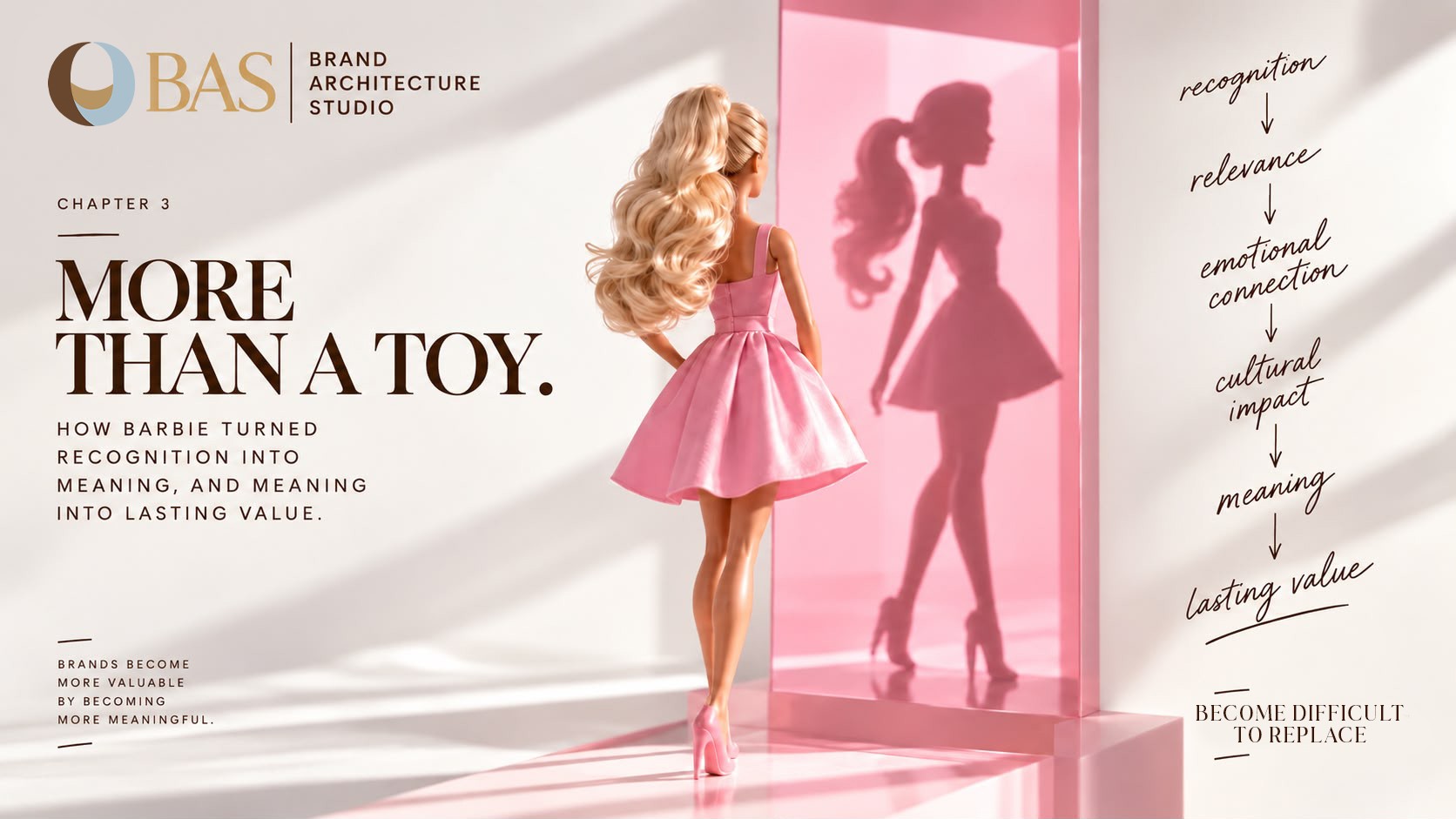
Barbie is useful because it makes the distinction among recognition, recalled meaning, relevance, and new value unusually visible.
Barbie has enormous recognition. Its name, color codes, silhouette, product history, and cultural associations have accumulated over generations. People who may never purchase a Barbie product can still recognize what the brand is and what it has represented in different periods of culture.
Historically, Barbie also carried meaning around possibility: the idea that a girl could imagine herself in many different futures. That meaning was never created by pink, a career doll, or any single campaign. Those elements were expressions through which a broader territory could be encountered.
As cultural expectations, identities, aspirations, and definitions of femininity changed, the strategic challenge became more complicated than preserving recognition. The question became whether the value associated with possibility remained consequential to new generations, and how that idea needed to evolve to remain relevant.
The 2023 Barbie film generated extraordinary attention and commercial impact. For many adults, it also interacted with accumulated memory. People who had known Barbie as children brought prior emotion, identity, familiarity, and cultural association into the theater. That is recalled meaning.
But recalled meaning among adults is not the same as new meaning forming among children encountering Barbie within a different cultural and commercial reality. Attention can reactivate accumulated value. It cannot tell us automatically what new value is being built, for whom, or whether that value will become difficult to replace.
The Meaning Value™ question is not whether Barbie is famous. It plainly is.
The question is what value Barbie provides to the children, parents, collectors, and cultural participants encountering it now, and what any of those groups would feel they were losing if another toy, entertainment property, creator, game, or platform became the alternative.
The Measurement Trap
Recognition produces numbers quickly:
Awareness
Reach
Impressions
Search volume
Conversation
Traffic
Earned media
Social engagement
Views
Sales spikes
Box office
Footfall
Share of voice
These measures can be useful. They can tell an organization whether people encountered the brand, whether communications reached an audience, whether attention increased, whether a campaign became visible, or whether a product was transacted.
The problem starts when a team uses those measures to answer questions they were not designed to answer.
Awareness can tell us whether people know the brand.
Sales can tell us that transactions occurred.
Retention can tell us that customers stayed.
None, alone, tells us which value caused the choice, what significance exists, whether persistence is driven by value rather than friction, or how easily a credible alternative could replace the important parts of the relationship.
A brand can be highly recognized and weakly valued. It can have high sales because it is widely distributed, heavily promoted, temporarily fashionable, bundled, or easy to buy. It can retain customers because contracts, data migration, routines, lack of alternatives, or switching effort make leaving inconvenient.
Those outcomes may be commercially important. They are not automatically proof of consequential value.
Do not ask an awareness metric to prove a relationship.
(Chapter 15 will return to this problem in detail. Its premise is simple: the evidence used must match the question the organization is trying to answer.)
Recognition Can Hide a Value Gap
Famous brands are particularly vulnerable to confusing familiarity with strength. Recognition can stay high while product value weakens, experience becomes ordinary, competitors improve, cultural relevance shifts, or a once-distinctive advantage becomes category standard. Because people keep recognizing the brand, leadership may not notice the erosion until later than it should. This is why discovery matters.
The question is not simply:
Are people still aware of us?
It is:
What do people actually value right now, and where are alternatives becoming equivalent?
A new brand faces the opposite problem. It may have real value but very little recognition. That does not mean the strategy is wrong. The market may simply not have had enough opportunity to encounter the proposition.
For a brand being built, part of the work is making value legible and creating enough awareness for people to evaluate it at all. But founders should resist treating early attention as proof that the proposition is consequential. Virality can create recognition before a business knows whether customers will return, pay, recommend, resist switching, or attach real significance to the brand.
Recognition is necessary in order to learn. It is not the learning itself.
A More Useful Sequence
The Meaning Value™ Framework does not propose a rigid funnel or deterministic ladder. But it does distinguish questions brand teams frequently collapse into one:
Dimesion
What it asks
Recognition: Do people know and retrieve the brand?
Relevance: Does the brand belong in this decision or situation?
Perceived value: What benefit does the customer believe it provides?
Consequential value: Does losing that benefit matter enough to affect choice?
Meaning: What significance has become attached to the brand?
Substitutability: How easily can another option reproduce the important value?
Irreplaceability: Would substitution create a consequential loss?
Iconicity: Has the brand's meaning become culturally legible at scale?
These ideas interact and can reinforce one another. They are not synonyms. The distinction matters because it prevents an organization from declaring victory too early.
Awareness is not value.
Value is not meaning.
Meaning is not automatically irreplaceability.
Cultural visibility is not immunity from competition.
What This Chapter Changes
Recognition gives value a chance to be encountered. It makes consideration possible. It can make communication and distribution more effective. It can improve retrieval in a relevant moment.
But recognition does not tell a brand what customers value, whether the brand is relevant, what significance has accumulated, or what a customer would genuinely lose by choosing something else.
Recognition gets a brand into the decision. Consequential value changes what happens when an alternative appears.
The next chapter turns to that value: its different forms, the conditions under which it becomes consequential, and the difference between genuine resistance to substitution and the simple friction of staying put.