David Yurman: When a Founder's Vision Becomes a Brand's Meaning
The cable that became the river that runs through everything
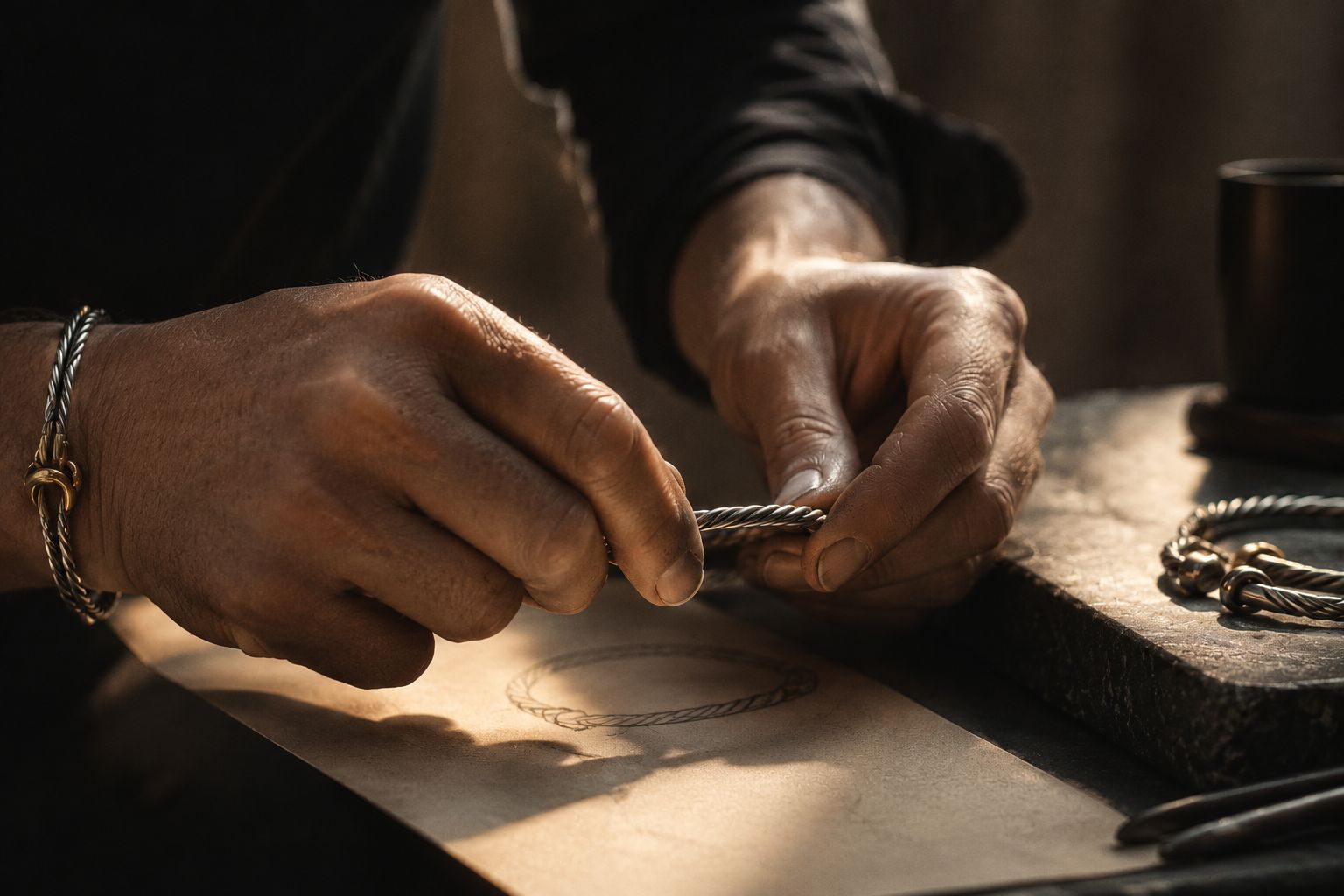
In the late 1970s, a sculptor sat in his Tribeca loft and twisted fifty feet of gold wire by hand into a bracelet for his partner Sybil. No commercial strategy. No brand brief. Just an artist making something beautiful for the person he loved, drawing on a visual obsession he had carried for years: helical strands of DNA, hanging vines, twisting columns, nautical ropes, suspension cables.
That bracelet became the Cable. And the Cable became David Yurman.
What happened next is one of the most instructive stories in brand strategy.
The Brand That Started as a Love Letter
David Yurman didn't begin with a positioning framework. It began with a specific artistic vision, one that had been developing across years of direct-weld sculpture and sketchbooks before it found its final form.
Founded in 1980, David and Sybil Yurman describe their company as "one long art project." That is not marketing language. It is the most precise possible description of what the brand actually is.
The origin story matters more than most brand strategists admit. When the founding act is genuine, a sculptor making something for the person he loves, the meaning that flows from it is genuine. It doesn't need to be manufactured. It needs to be protected.
The Difference Between a Signature and a Visual Identity
Every brand has a visual identity. Very few brands have a signature.
A visual identity is a designed system, logos, colors, typography, built by designers working from a brief. It can be updated, refreshed, or repositioned when the market demands it.
A signature is different. It is the visible expression of a specific person's way of seeing the world, their artistic obsession, the visual idea they return to because it feels essential to how they understand beauty and structure.
The Cable is David Yurman's signature in the most literal sense. He calls it "the river that runs through everything we do”, "a principle of classicism in purity of form." That is an artist describing a primary visual obsession. Not a brand manager describing a brand element.
The distinction matters enormously. When a brand element is a designer's creation, it can be changed. When it is a founder's signature, the expression of genuine artistic conviction it cannot be changed without ceasing to be the brand.
Remove the river, and there is no David Yurman. There is a jewelry company, competently run, making attractive pieces. The meaning would be gone.
When a brand's meaning is rooted in a founder's genuine artistic vision, the meaning is not a strategic choice. It is a fact. And facts are more durable than strategies.
The Territory Tiffany Couldn't Occupy
The American jewelry market was defined by two poles. At one end: heritage fine jewelry houses, Tiffany, Cartier, Van Cleef & Arpels. Status, occasion, investment, legacy. On the other: fashion jewelry, trend-driven, accessible, seasonal.
Between those poles sat a significant, underserved territory. Jewelry that was genuinely designed, genuinely crafted, and carried genuine artistic meaning, but didn't require a milestone occasion or a significant inheritance to purchase.
David Yurman occupied that territory and created a new category of meaning. Not heritage luxury. Not fashion. Art made wearable at a scale that allowed a much broader audience to participate.
The Cable at its entry price point sits within reach of a young professional buying her first serious piece. At its upper range, it sits alongside fine jewelry as a considered purchase. That range, accessible at the bottom, aspirational at the top, is itself a meaning statement: this is for people who value design and craft, regardless of where they are in their financial life.
The Founder-Led Brand Problem and the Architectural Solution
Every founder-leader-led brand eventually faces the same challenge.
The founder's vision is the brand's meaning. But founders are finite, in time, in attention, and eventually in daily presence. What happens to the meaning when the founder steps back?
Most founder-led brands struggle here. The meaning that was natural when expressed by the person who genuinely held it becomes performed and strained when a team tries to approximate what the founder would have done.
David Yurman navigated this more successfully than almost any comparable brand. The reason is architectural, not personal.
The Cable is not a style. It is a structural principle, a visual language with its own grammar, capable of generating infinite variations while remaining unmistakably itself.
The architectural solution to the founder-led brand problem: codify the founder's vision not as a style to be imitated, but as a structural principle to be applied. Give the brand a DNA, a visual grammar, a recurring motif, that anyone who understands it can express, without requiring the founder's daily presence to feel genuine.
"Having been around the business from an early age, I have great pride for our classic style and founding identity," said Evan Yurman, chief creative officer. The pride is genuine. But more importantly, the style and founding identity are clear enough that someone other than the founder can hold them with conviction.
What Happens When Personal Meaning Accumulates
For many wearers, the Cable bracelet is a milestone object. A graduation gift. A first significant piece of adult jewelry. A gift from a mother to a daughter. Something received at a moment that mattered and worn thereafter as a physical reminder of that moment and that relationship.
This accumulation of personal meaning, layered on top of the brand's inherent artistic meaning, is one of the most powerful forces in consumer products. The object carries two kinds of meaning simultaneously: the meaning of the brand built through design and craft, and the personal meaning each wearer attached through the circumstances of receiving it.
That layering is what makes the Cable genuinely difficult to replace.
"It was unique, and that has been one of the reasons they've been successful for so long, this unwavering point of view. To have that sort of clarity is very powerful," said Virginia Smith, accessories director at Vogue.
Unwavering point of view. The Cable has been the same cable, in its essential form, in its structural principle, for over four decades. That consistency is the foundation of multigenerational brand loyalty.
What Is Your Cable?
Most founder-led brands today are not legacy luxury houses. They are built around a specific person's vision, taste, expertise, or conviction, and they are trying to understand how that personal vision becomes a durable brand meaning rather than a personality that depends on the founder's constant presence.
The answer is not to make the founder's presence less important. It is to codify the founder's vision so precisely, to find the Cable, the structural principle, the river that runs through everything, that the vision becomes legible and transmissible, independent of the founder's daily involvement.
Not the logo. Not the color palette. Not the tagline. The fundamental visual or strategic principle that is so genuinely expressive of the founder's vision that it becomes the brand's defining identity.
The Cable was David Yurman's recurring dream, a form that appeared in his work before he understood what it would become. Finding that principle, and building the discipline to apply it consistently, is the work that transforms a founder's personality into a brand's meaning.
When you find it, it will feel less like a strategic choice and more like the thing that was always going to be true.
Brand Architecture Studio works with founders and CMOs to identify the structural principle, the Cable, at the heart of their brand. If you're building a founder-led brand and want to close the meaning gap, visit brandarchitecturestudio.com or reach out directly.
(c) Brand Architecture Studio 2026. All rights reserved.